You Spend
Thousands to Get
a Resident. Then
You Go Quiet.
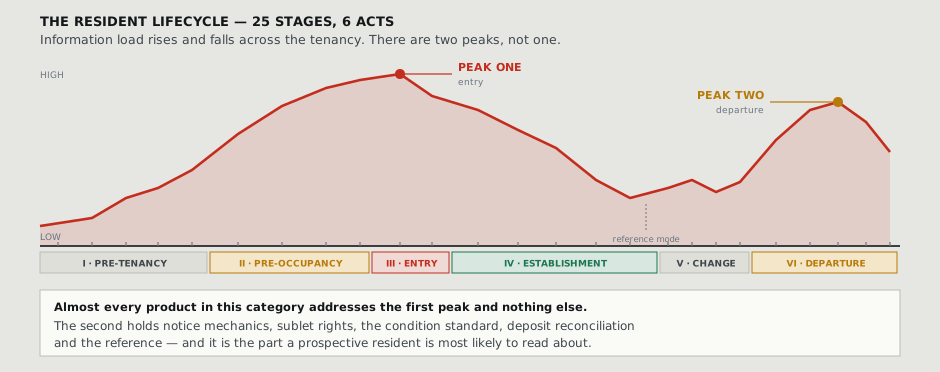
A new tenant signs, gets a key and a login, and discovers that nobody has told them how to live in the building. Four of the five most common move-in complaints are information failures wearing an operational costume. That is a cheap problem to fix and an expensive one to ignore.
The problem is not your team
Leasing is measured on signatures, and its attention ends at the signature. Operations inherits a resident it never met, carrying expectations it cannot see. The property management software vendor's scope ends at "we gave you a documents area."
Nobody owns the seam. So the information a new resident needs — how the waste actually works here, what counts as an emergency at 11pm, where the parcels go, what happens if they give notice — falls straight through it.
It is also genuinely hard. A complete building guide needs knowledge held across the superintendent, the property manager, the waste contractor, the fire safety plan, the municipality, three utilities and the lease. Nobody holds all of it.
And it decays. On 1 January 2026 the City of Ottawa stopped collecting residential recycling. Buildings of six or more units occupied from 2026 are excluded from the provincial programme until 2031 and need a private contract. Every handbook in this city written before December 2025 is now wrong about garbage.
Onboarding software is a solved problem. Onboarding content is not.
What we do
We write what your building should have been telling residents — and we keep it true.
Five questions in ninety seconds, or the full ninety-item assessment in under twenty minutes. Ungated, no email, nothing leaves your browser. Most operators land in the thirties and do not believe it.
Two weeks. One site visit, a superintendent interview, and independent verification of every item against evidence — including the municipal and provincial content you have no mechanism to check yourself.
Every gap classified: Relocate (it exists, it is just in the wrong place), Revalidate (it drifted), Author (it does not exist). Sequenced by consequence, then by effort, so the quick wins surface first.
The building manual, the stage-by-stage delivery sequence, the signage kit, the in-suite emergency card, one condition instrument used at both ends, and the municipal and provincial modules you inherit rather than write.
Quarterly revalidation of municipal and vendor content, annual review of provincial content, and notice when something changes underneath you. This is the part nobody else does, and it is the part that decays fastest.
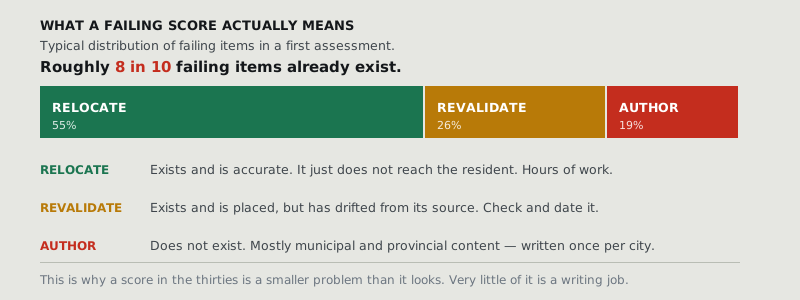
In buildings that complete a full assessment, roughly eight out of ten failing items already exist. They are written, they are somewhere in your systems, and they fail only because they are out of date or because they never reach the resident at the moment of the decision. Very little of this is a writing job. It is a placement-and-maintenance job, and that is a much smaller bill than the score suggests.
What it costs
Self-Assessment
- All 90 scored requirements
- Your Building Threshold Score
- Critical gates and stage floors
- Your own remediation list
Verified Audit
- Site survey and superintendent interview
- Independent verification of all 90 scored items
- Variance against your own score
- Critical gate register
- Sequenced work order
- 60-minute readout
Each Additional
- Everything in the audit
- Portfolio consistency report
- Shared-content register — what to write once for all of them
Not a volume discount. Municipal verification carries across buildings in a city, so the second genuinely costs less to do.
Production
- The work order, executed
- Manual, sequence, signage kit, emergency card
- Inherited municipal and provincial modules
- Re-scored on completion
The audit fee credits in full against a production engagement booked within sixty days. Not a promotion — the audit produces the production scope, so you should not pay twice for the same discovery.
Where a building actually earns its reputation
Safety, done properly
Most residents assume every fire alarm means evacuate. Many high-rises are designed on a defend-in-place or staged basis, where leaving may be the more dangerous action — and the correct answer is knowable only from that building's own fire safety plan.
The standard scores fourteen emergency scenarios separately, each critical, each required to be readable with no power and no phone: fire, corridor smoke, elevator entrapment, flood, outage, winter heat loss, carbon monoxide, gas, medical, intrusion, severe weather, lithium battery fire, lockout. Plus the voluntary assistance list almost no building tells residents exists.
Concierge, as a differentiator
Everything else in this standard describes a floor. The concierge layer is the one place a building can be conspicuously better than the one across the street, and it is the cheapest such advantage there is.
A curated Building Map — one link, one printed sheet, one QR at the mailbox — covering daily needs, laundry and dry cleaning, health with the late-opening pharmacy named separately, transit, civic services, food, settlement support and local seasonal knowledge. Every pin carries hours and one line of usefulness.
It is the only conformance item a resident sees on day one, before anything has gone wrong.
A directory says where the pharmacy is. A concierge knows the one on the corner shuts at six.
Why us
The standard is published in full and free to read, and the self-assessment is ungated with no email wall. You can reach Level 1 without buying anything from us, and if that ever stops being true the standard has failed at its job.
We publish our own corrections too. Re-verifying this material in August found four things our own first edition got wrong — including that the 2031 recycling exclusion catches buildings already on private collection, not only new builds.
That is not an embarrassment. It is the argument. Seven months was enough for our own carefully-sourced content to drift, and we were watching for it. Your handbook has been drifting since 2023, and nobody has been watching at all.
CIONAOD Inc. is a publishing company in Kanata, Ontario. We write things and keep them accurate. That is the whole proposition.
Not legal advice, and not a determination of compliance with anything. Statutory findings describe what the standard requires and what was observed, and should be reviewed with your own counsel. Not a building condition assessment, and not a review of your fire safety plan — that is a regulated activity for qualified professionals.
Start with the number
Score your building. It is free, it takes eight minutes, and we never see the result.
buildingthreshold.com/score — or the full assessment at buildingthreshold.com/assessment.
When you want it verified: hello@buildingthreshold.com · buildingthreshold.com/audit
BUILDINGTHRESHOLD.COM · CIONAOD INC., KANATA ON · THRESHOLD EDITION 1.1 · VERIFIED 9 AUGUST 2026 · INFORMATIONAL ONLY, NOT LEGAL ADVICE