Your building
has a portal.
It's empty.
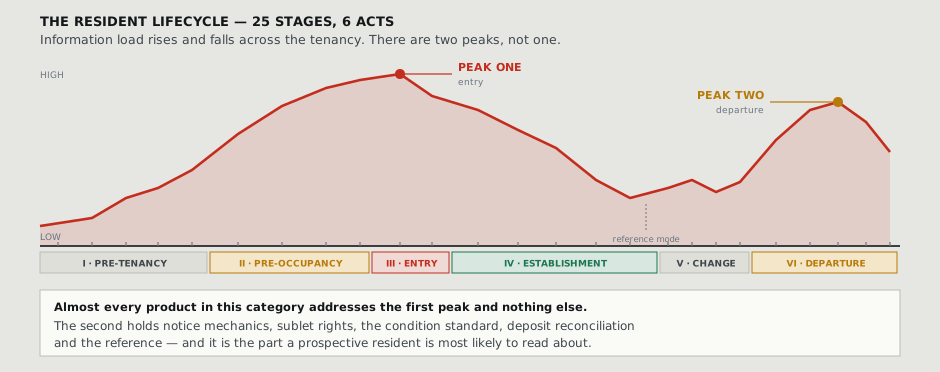
Operators spend thousands acquiring each new resident, then hand them a key and a login that explains almost nothing about how to live in the building. THRESHOLD is a free, auditable standard for closing that gap — twenty-five lifecycle stages, from the first listing view to the day the file is closed after someone leaves.
By-law 2020-255 has required an information document for every tenant since 2021 — kept current, with emergency evacuation content and a tenant support register. On 1 January 2026 the City stopped collecting recycling, which means most Ottawa documents went out of date and the by-law gave you thirty days to say so. Six questions to see where you stand.
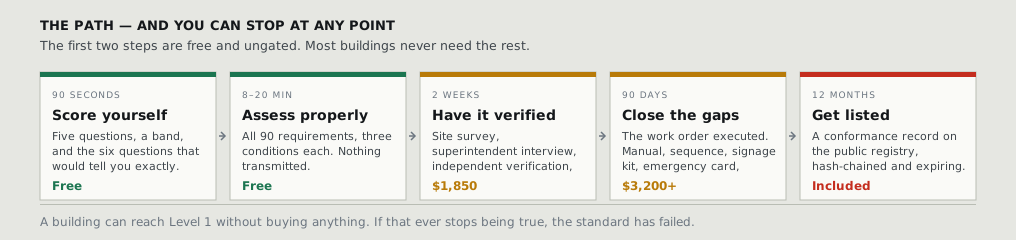
Score your building in ninety seconds
Five questions, an honest estimate, and the six questions that would tell you exactly. No email required; your answers stay in your browser.
Start the short score → If you're moving inBuild your own move-in checklist
Everything your building should have told you, sequenced by date. Ontario rules, real lead times, and the things that go wrong if you leave them late.
Generate a checklist → If you’re on siteThe superintendent's field guide
The eight questions residents actually ask, where each answer should live, and the eight places a sign earns its keep. Free, and written for site teams rather than about them.
Read the guide → If you live in OttawaFind out who actually collects your recycling
It changed on 1 January 2026, and it isn't the City any more. For some buildings it changed again. Most handbooks still have it wrong.
Check your building →The gap, measured
What the standard says
Three principles govern everything else, and each of them is a claim that existing practice gets wrong.
Information delivered at the wrong moment is functionally undelivered. A forty-page handbook issued at lease signing satisfies nothing — it arrives when the resident cannot act on it, and it is unfindable when they can.
A waste-sorting rule sent by email is not a delivered waste-sorting rule. It has to exist at the waste room door, at the moment of the decision, in front of someone holding a takeout container and three identical bins.
Wrong information is worse than absent information, because it creates reliance and reliance creates liability. Every item carries a source and a review date, and an item past its review date scores zero — not partial credit.
The name is the architecture
The name is the architecture. T is the timeline — the axis everything else is arranged along. The remaining eight letters are the content pillars.
| Element | Count | What it governs |
|---|---|---|
| Lifecycle stages | 25 | From first listing view to post-tenancy file closure, in six acts |
| Information types | 12 | What kind of communicative act each item is — which determines its format, mode and review cycle |
| Delivery modes | 4 | Push, pull, ambient, evidenced — where information has to physically be to count as delivered |
| Requirements | 71 | The scored items, across three cumulative conformance levels |
Recently changed
Rules that make a tenant handbook wrong, logged as they happen. If your building's information hasn't been reviewed since these dates, it is out of date.
Blue box collection moved to the provincial producer-run program, administered by Circular Materials and collected by Miller Waste. The accepted materials list changed at the same time.
Buildings of six or more units ready for occupancy from 2026 onward are not eligible for the provincial program and need a private recycling contract to receive City garbage collection at all.
Multi-residential properties must participate in the organics program to receive waste collection services from the City.
A standard nobody can read is a sales gimmick. BuildingThreshold publishes the THRESHOLD standard and its self-assessment openly and ungated, and they will stay that way. CIONAOD Inc. sells verification and production services to operators who want help closing the gap — but the standard is useful without them, and it is meant to be. More about that here.