The Superintendent's
Field Guide
The questions residents actually ask, and how to answer each one once instead of forty times. Nobody writes anything for site staff. This is an attempt to fix that.
You are not a search engine. Every question a resident asks you is a question the building failed to answer, and most of them are the same eight questions. This guide is about converting each one from a conversation you have repeatedly into something that answers itself.
The eight questions
| The question | Where it should live | Why answering it in person doesn't work |
|---|---|---|
| "Which bin does this go in?" | A sign on the waste room door | They're holding the item, they're not going to find you, and if you're not there they'll guess. A guess is a contamination charge. |
| "How do I get a parcel that says delivered?" | A sign at the mailbox bank | Peak parcel confusion happens evenings and weekends. The answer has to be there when you aren't. |
| "Is this an emergency?" | The move-in pack and a card inside the unit door | Residents get this wrong in both directions — calling you at 2am about a light bulb, or not calling at 2am about water. The second one is far more expensive. |
| "There's no power in half my apartment." | A label at the panel | It's a tripped GFCI roughly four times out of five, and a callout for a reset costs more than a label ever will. |
| "Why is there water on my windows?" | A seasonal briefing, every autumn | Winter condensation becomes mould becomes a habitability complaint. It's a humidity behaviour nobody explained, and it is entirely preventable with one email a year. |
| "When can I book the elevator?" | A sign in both elevator lobbies | They ask on the day, with movers already charging by the hour, and by then it's too late for the answer to help. |
| "Where do I put these boxes?" | The move-in pack, and a sign on move-in day | Move-in cardboard is the single most predictable waste violation in your year, and the resident genuinely doesn't know. |
| "Am I allowed to…?" | Delivered in the first month, before enforcement | Enforcing a rule that was never stated reads as a trap. Stating it first turns the same enforcement into consistency. |
There is a placement capture tool that walks you through all eight with your phone and produces one evidence file. Works with no signal, nothing is uploaded, and it is yours whether or not your building ever engages anyone.
Eight places a sign earns its keep
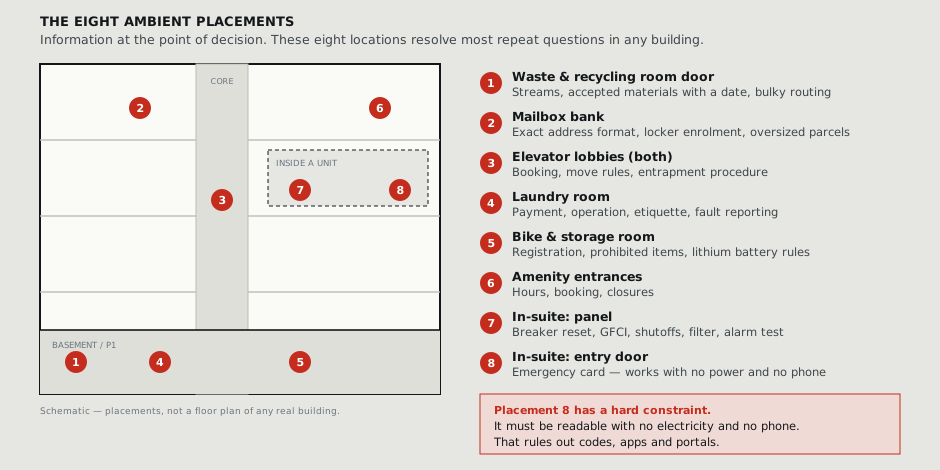
The standard calls this ambient placement: information at the point where the decision gets made, not in a document sent six weeks earlier. These are the eight locations that carry almost all of the load.
- Waste and recycling room door — current stream rules, what each takes, bulky and hazardous routing, collection days.
- Mailbox bank — the exact address format including where the unit number goes, parcel locker enrolment, oversized parcels.
- Both elevator lobbies — booking procedure, move rules, and what to do if someone is trapped.
- Laundry room — payment method, machine operation, etiquette, how to report a fault.
- Bike and storage room — registration, prohibited items, and lithium battery charging rules, which are tightening quickly.
- Amenity entrances — hours, booking, rules, closure notices.
- Inside the unit at the panel — breaker reset, GFCI locations, shutoff valves, filter, alarm test.
- Inside the unit entry door — the emergency card: unit number, emergency line, exits, and whether this building evacuates or defends in place.
The in-suite emergency card has to be readable with no power and no phone. That is precisely the situation in which it is needed, and it is the reason it cannot be a QR code or a portal page. Print, laminate, mount inside the entry door. It is the cheapest life-safety measure available in a residential building.
Your knowledge is the building's biggest single point of failure
Most of what makes a building work is undocumented and lives in one person's head: which chute jams, which breaker is mislabelled, which entrance the couriers actually use, what the seasonal changeover really means in practice. When that person leaves, it leaves with them.
Writing it down is not a threat to your position — it is the difference between being the only person who can run the building and being the person who built the system that runs it. It is also, practically, how you take a holiday without your phone going.
The self-assessment takes about eight minutes and produces a score for your building. It is free, nothing is transmitted, and a superintendent showing their property manager a low score tends to start a more productive conversation than a superintendent asking for signage.